
Update on Journalism and Media Safety in Myanmar [April – June 2026]
Highlights
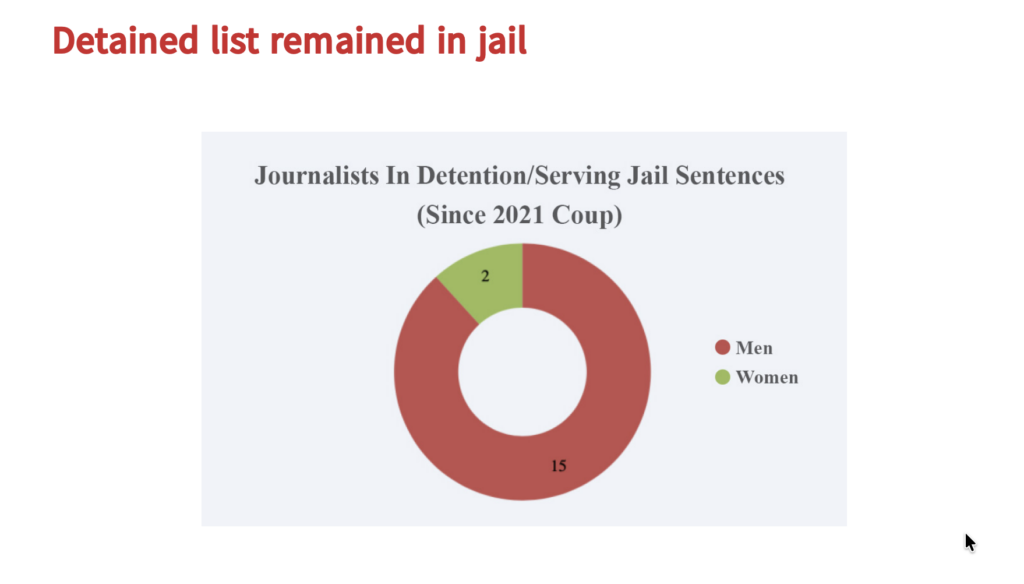
In the second quarter of 2026, one journalist was released from prison from amnesty in April and there was no new arrest. There was no new conviction. By the end of June 2026, 17 are still in jail. Overall, 216 journalists have been arrested since the coup, with 17 still in detention and 11 deceased cases.
The regime revoked the operating licenses of six media outlets this quarter, bringing the total number of revoked news licenses to 22 since the coup.
The junta continues to weaponise the legal system to systematically suppress independent journalism, relying primarily on counter-terrorism, national security, and broad speech-related laws to criminalise reporting. Journalists are frequently charged under multiple overlapping provisions.
The junta is institutionalising disinformation by replacing independent news with state-run propaganda and utilising pro-regime influencers on Telegram and TikTok. The junta has also established an inter-ministerial “Information Sheet” team to oversee psychological warfare and disinformation operations.
In Rakhine, female field reporter Khin Tharaphi Oo received online sexual harassment, verbal abuse, and physical threats following a social media disagreement. Salween Khet News has publicly condemned the incident and requested that the United League of Arakan/Arakan Army investigate the case.
A group of independent journalists established the Arakan Press Council (APC) to support ethical reporting and enhance journalist safety while operating independently of governing authorities.
IPCM launched a media safety and protection program in April 2026 to support journalists in emergency relocation and legal residency documentation by considering that the displacement and struggles are going for long-term.
There was no new arrest in the second quarter of 2026.
Releases
The only media worker who was released in the second quarter is Shin Daewe, documen-tary filmmaker, from amnesty on 17 April. She was arrested in October 2023 in Yangon and was sentenced to life in prison under section 50(j) of the Couter-terrorism Law.
Orchestrated transition and license revocations of six media outlets
Within a month of its establishment, the new administration of former military junta leader Min Aung Hlaing proclaimed itself an elected civilian government by releasing over 4,000 prisoners to coincide with the April 17 Myanmar New Year. Among those pardoned was the deposed democratically elected President, U Win Myint, alongside prominent activists, and student leaders. Among those, only one journalist was included in the release which is Shin Daewi, documentary film maker. The regime also announced that Aung San Suu Kyi’s 27-year sentence had been reduced to 18 years and that she was being transferred from prison to house arrest. Kim Aeris (Aung San Suu Kyi’s son) has been leading a global campaign called for “Proof of life” to provide proof of her alive.
Within a month of its establishment, the new administration of former military junta leader Min Aung Hlaing proclaimed itself an elected civilian government by releasing over 4,000 prisoners to coincide with the April 17 Myanmar New Year. Among those, only one journalist was included in the release which is Shin Daewi, documentary film maker.
However, the military continues to rely on emergency ordinances and martial law to maintain strict control across 60 townships in regions including Kachin, Kayah, Kayin, Chin, Shan, Rakhine, Sagaing, Magway, and Mandalay. The list of offences that can be tried by a military court (in places under martial law) still includes the News Media Law and the Printing and Publishing Enterprise Law. Consequently, it increases the risk that citizen journalists and journalists from certain regions could be arrested and put on trial in a military court without access to legal representation for engaging in journalistic activities.
In the meantime, the regime’s Ministry of Information revoked the operating licences of six media outlets – three Chin media outlets: Khonumthung Media Group, Chin World and Nowadays News in April, and Myaelatt Athan, Red News Agency and Asia Citizens in May. There have now been seven revoked media outlets (Shwe Phee Myay news agency’s licence was revoked in January 13) since the military’s leader Min Aung Hlaing attempted to showcase its unreal civilian transition. The revocation prohibits these outlets from publishing or distributing news through any medium or technology.
Nowdays News issued a statement on April 24 declaring that press freedom cannot be silenced.
It stated that
The hands that hold cameras and the hands that hold pens will never serve dictatorship. This announcement by the coup military declaring the closure of our media outlet has no legal legitimacy, and we do not regard it as worthy of recognition. We will continue reporting the truths that the public has the right to know and delivering news from the ground through every possible means, regardless of the obstacles we face. Under any pressure, we will continue to stand with the people and uncover the truth in accordance with journalistic ethics.”
However, Nowadays News informed that in order to re-establish itself in a stronger and renewed form, it will temporarily suspend its news reporting and content production from 5 July 2026 to 30 September 2026.
In an interview with DVB, Ko Win Zaw Naing, Managing Editor of Red News Agency, stated that
We will continue our work in support of media freedom. Even if they shut us down, we are not
concerned. Ever since the military seized power, we have continued reporting – from the
time of the peaceful protests until now. During that period, journalists were arrested, and
some were even killed. So, compared with those experiences, this closure is not
something we are particularly worried about. We will simply continue doing our work.”
It is criticised that these actions are simply a continuation of the same approach taken since the beginning of the coup, with nothing having changed in terms of methods except for a change in names. In the interview with Mizzima news, U Ko Ko Zaw, Chair of IPCM stated that
They've only taken off the uniform, but they are still operating in the same way as they have since the coup began. The only thing that has changed is the name - from Senior General to U Min Aung Hlaing. Other than that, there has been no change in their methods or practices whatsoever.
The military authorities accused these outlets of violating the Printing and Publishing Enterprise Law (2023 amended by the junta) by publishing content that threatened national security and the rule of law.
Since the military coup, the junta has revoked the operatinglicences of 22 newspapers and 12 printing/publishing permits in Myanmar. Reporters without borders released that press freedom has been at the lowest average in 25 years around the world and Myanmar remains in the list of top of the worst.
Regime-led Myanmar media development group
In momentally building up the counter-media landscape, the regime established Myanmar media development group (MMDG) in 2023 stating that they aim to develop private media sectors which align media ethics and work on social responsibility. On 22 April 2026, new statement was released to reconstitute MMDG and promote cooperation with domestic and international organisations. According to its composition, it is still a state-led (regime-led) body rather than an independent multi-stakeholder mechanism. It is chaired by the Deputy Minister of Information and administered by senior officials from the Ministry of Information’s media development department.
Although the group includes some other representatives from associations such as the Myanmar Press Council, Myanmar Broadcasters Association and Foreign Correspondents Club, many of these groups have been criticised for accommodating military authorities rather than representing independent journalism. The most significant aspect of the statement is Clause 2(b) which identifies occasionally organising training programs, lectures, workshops, and seminars in collaboration with media development organisations, including UNESCO’ that clearly reveals an intention to project an illusion of cooperation with
UN agencies like UNESCO and other international development organizations. In reality, however, partnerships exist almost exclusively with entities from countries such as China and the Russian Federation.
The repeated references to cooperation with international media development organisations tells that the regime is actively seeking international engagement to boost the credibility of the MMDG. (See appendix for the statement).