Dead Air : A Study of Communication Shutdowns in Conflict-Affected Areas of Sagaing Region and Northern Mandalay Region
1. Executive Summary
Communication shutdowns have consequences that extend far beyond the inability to make phone calls or access the internet. When people cannot obtain warnings about airstrikes and military movements, medical assistance, information about the safety of family members, or information about evacuation routes, their daily decisions, lives and safety are directly affected.
This report combines survey responses from (130) respondents, covering (24) principal townships in Sagaing Region and northern Mandalay Region, with a separate interview with an official from a local education organization, case studies and external data. It examines how people living in areas affected by communication shutdowns obtain information, the risks they encounter and which groups are more likely to be left behind.
Among the respondents, (92.3) percent could not reliably access conventional communication networks. Some communities have therefore established alternative systems using ICOM radios, satellite internet, loudspeakers and person-to-person information networks. However, these alternatives are neither accessible to everyone nor consistently reliable. They may be disrupted or rendered unusable by attacks and restrictions imposed by the Myanmar military, controls over access exercised by resistance forces in some areas, decisions made by service providers and local security conditions.
Fewer than half of the respondents reported receiving emergency warnings in time. To access communication services, some people must spend more money, travel for hours and pass through checkpoints or areas near active fighting. Civilians therefore bear the costs and risks created by both the shutdowns and the instability of alternative communication systems at the expense of their time, finances and personal safety.
Communication shutdowns restrict not only access to information but also the ability to verify news, document casualties, communicate the need for assistance to the outside world and obtain necessary assistance. The divide between those who have access to communication and those who do not has consequently become more than an information gap. It is now a divide in safety, health and the ability to survive.
Respondents identified ICOM radios and satellite internet as key communication needs during emergencies. The report therefore recommends prioritizing communities that remain completely disconnected and expanding the alternative communication networks currently used by local communities so that they become safer and accessible to more people. Achieving this will require coordinated action by resistance forces, including the National Unity Government, Myanmar civil society organizations, non-governmental organizations, news media and the international community.
2. Background
Since the military coup on 1 February 2021, access to reliable information has become a critical issue directly affecting the safety and survival of people in Myanmar. Following the coup, the military authorities shut down mobile data and telephone services, blocked social media platforms and news websites, and restricted Virtual Private Networks (VPNs) and other means of online communication, both nationwide and in specific areas. These measures gradually expanded into a system of digital repression encompassing strategic communication shutdowns, information censorship, surveillance, and the blocking of methods used to circumvent internet restrictions. According to the Office of the United Nations High Commissioner for Human Rights (OHCHR), internet and telephone shutdowns, online censorship, and surveillance continued to restrict freedom of expression and the right to access information throughout 2024.
The Myanmar military has increasingly targeted strong armed resistance areas with communication restrictions and shutdowns. Access Now verified and documented 85 communication shutdowns in Myanmar in 2024, the highest number recorded in any country that year. Of these documented incidents, 74 were imposed by the Myanmar military, making it the principal perpetrator of communication shutdowns. Thirty-one shutdowns coincided with documented serious human rights violations, and at least 17 of the military-imposed shutdowns were associated with airstrikes targeting villages inhabited by civilians. Restrictions on satellite internet services such as Starlink and IPSTAR, which communities increasingly used as alternatives when regular communication networks were disrupted, were also documented in 2024.
Athan’s monitoring and documentation identify three patterns of communication restrictions in Myanmar: nationwide shutdowns, targeted shutdowns in specific areas or individual townships, and shutdowns imposed at particular times.3 These restrictions do not result solely from the direct cutting of communication lines. They are also associated with damage to communication infrastructure, power outages, restrictions imposed on telecommunications providers, confiscation of communication equipment, blocking of online platforms and circumvention technologies, and security conditions that prevent technical repairs to damaged networks. Consequently, communities face complete communication outages, intermittent access, weak signals, and dependence on alternatives that are insecure, costly, and potentially dangerous. Although people in areas affected by communication shutdowns have increasingly turned to alternatives, including Starlink and other satellite internet services, these services remain subject to constraints involving cost, security, and accessibility.
The effects of these restrictions extend far beyond the loss of conventional telephone and internet services. According to analyses by United Nations human rights experts, communication shutdowns not only make it difficult for people to communicate with one another and request assistance, but also obstruct humanitarian organizations’ relief operations and the flow of information to news media and human rights monitors. In situations of armed conflict, communication shutdowns may also intensify violence and security risks and adversely affect other rights, including access to healthcare, education and livelihoods.4 Against this background, this study examines how communication shutdowns affect access to warnings about airstrikes and military movements, information about the safety of travel routes, communication with family members, access to medical and emergency
assistance, and decisions about whether to remain at home or relocate to a safer place.
These risks are particularly severe in central Myanmar, including Sagaing Region and northern Mandalay Region. According to a March 2025 report by the United Nations Office for the Coordination of Humanitarian Affairs (UNOCHA), fighting, airstrikes, landmine attacks, raids and arson continued across northwestern Myanmar, which includes Chin, Magway, Mandalay and Sagaing,
making it one of the areas with the highest levels of internal displacement. The Office of the United Nations High Commissioner for Human Rights (OHCHR) also identified Sagaing and Mandalay among the areas most severely affected by conflict in its report covering 2024.5 In March 2025, the United Nations reported that approximately half of all internally displaced people in Myanmar were located in the northwestern region. Fighting and airstrikes in Madaya and Thabeikkyin townships also displaced thousands of people, while communication restrictions made it difficult to verify population movements and humanitarian needs.
Following the major earthquake that struck central Myanmar on (28) March 2025, the humanitarian importance of communication systems became even more evident. The earthquake caused extensive damage to buildings and infrastructure across central Myanmar, including Sagaing and Mandalay. Even before the earthquake, these areas had already been affected by conflict, displacement and inadequate basic services. Blocked roads and communication disruptions made it difficult during the initial response to determine and verify the scale of casualties, displacement and emergency assistance needs. The disaster demonstrated that the effects of communication shutdowns are not confined to situations of armed conflict. During natural disasters, they can also impede early warnings, efforts to locate and contact family members, emergency response operations and access to assistance.
During communication shutdowns, communities have adopted various alternative methods to obtain and share information. These include Starlink and other satellite internet services, two-way radios, community-level early warning networks, loudspeaker announcements, radio and television programmes, trusted local leaders, person-to-person information sharing and travelling to locations where communication networks are available. However, these alternatives are not equally accessible to everyone. Satellite internet services can be expensive, may need to be shared among many users, can be difficult to reach and carry the risk of being prohibited or having the equipment confiscated. Travelling to locations with network access can also expose people to checkpoints, armed clashes, airstrikes, landmines and other security threats. Information shared through informal networks may arrive late, be incomplete or be difficult to verify.
However, reliance on Starlink satellite internet as an alternative means of communication makes local organizations dependent on SpaceX’s policies and decisions, which remain beyond the control of Myanmar organizations. A coalition of (317) Myanmar civil society organizations has expressed concern that SpaceX’s efforts to disable Starlink terminals in order to combat cyber-scam
operations prevalent in Myanmar’s conflict-affected areas could also cause widespread disruption to satellite internet services used by civilians, thereby affecting a critical communication channel in areas where the military has shut down internet access.
Reports and monitoring studies published by civil society organizations and international organizations have primarily documented the frequency, location and duration of communication shutdowns, together with their effects on digital rights and human rights. Although these records are essential for understanding the scale of communication restrictions, further research is needed to develop a deeper understanding of how affected communities obtain information in their daily lives and the alternative communication methods they use in practice. In particular, systematic examination is needed of the information channels available during communication shutdowns, the people who manage those channels, the costs of using them, the speed at which emergency warnings are received, the methods used to verify information and the groups that experience the greatest difficulties in accessing information.
This study seeks to address this evidence gap by examining access to information in conflictaffected townships in Sagaing Region and northern Mandalay Region. It considers communication shutdowns not only as restrictions on digital communication and freedom of expression, but also as threats to civilian safety, the ability to contact family members, access to basic and emergency services and community resilience. By documenting the effects of communication shutdowns and how communities respond to them, the study aims to provide useful evidence for civil society programmes, humanitarian communication initiatives, community-based early warning systems and advocacy for communication rights in Myanmar.
3. Research Methodology and Limitations
This study employed a mixed-methods approach combining quantitative and qualitative methods. Between (30) August and (12) September 2026, a survey consisting of (43) questions was administered to (130) respondents from (24) purposively selected townships in Sagaing Region and northern Mandalay Region. Three data collectors familiar with the local context collected the data in person, by telephone, through the internet and through trusted local communication networks.
In addition to the survey responses, a separate key-informant interview was conducted with an official from a local education organization to develop a deeper understanding of communication shutdowns, the use of ICOM radios and Starlink, community warning networks and the practical experiences of local people. Responses to closed-ended questions were analysed using frequencies and percentages, while responses to open-ended questions and the key-informant interview were analysed thematically. Participants’ consent was obtained, and directly identifying personal information was not recorded for security reasons.
Because the townships and respondents were not randomly selected, the findings cannot be generalized to represent the experiences of everyone living in the study area. Other major limitations include difficulties in reaching areas experiencing the most severe communication conditions, reliance on self-reported information and the rapidly changing conflict environment.
4. Research Findings
4.1 Realities under Communication Shutdowns
4.1.1 Respondent Background and Analytical Notes
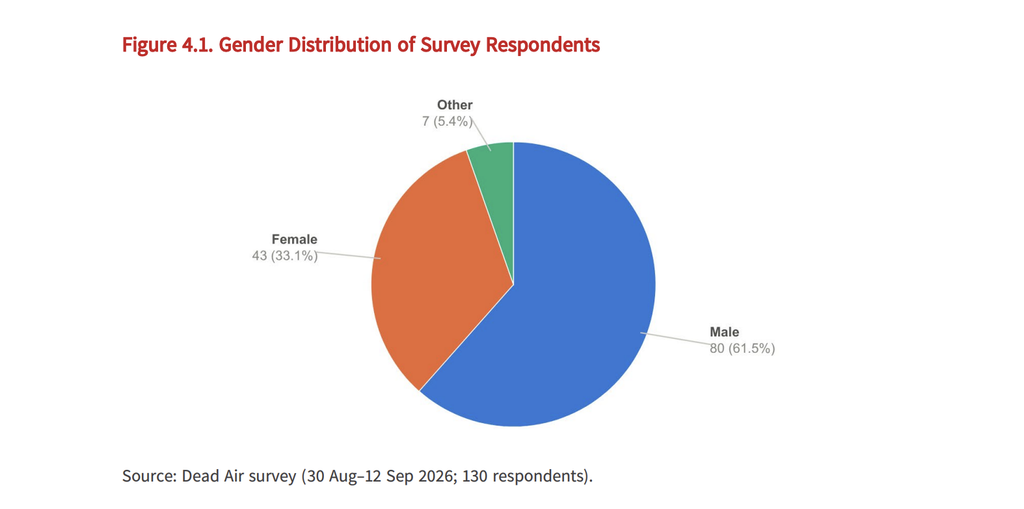
Data for this study were collected by (3) local data collectors between (30) August and (12) September 2026. The survey was conducted in conflict-affected areas spanning central and northwestern Myanmar, primarily covering (21) townships in Sagaing Region and (3) townships in northern Mandalay Region. It also included responses from (1) respondent from Pauk Township in Magway Region and (2) respondents whose townships were not disclosed for security reasons. Data were collected by telephone, in person and through trusted local networks, producing a total of (130) responses.The proportions of respondents by self-identified gender are presented in Table (4.1), while their distribution by age is presented in Table (4.2)